
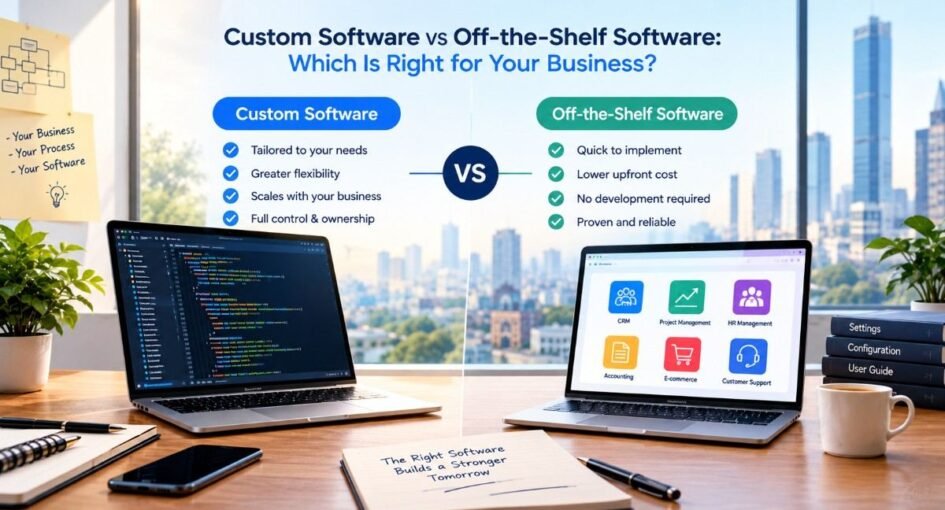
Choosing the right software can have a major impact on how efficiently a business operates, serves customers, and scales over time.
Many businesses face the same question: Should we invest in custom software or choose an off-the-shelf solution?
Off-the-shelf software is often quicker to deploy and can be suitable when your business needs are fairly standard. Custom software, on the other hand, is built around specific business processes and can provide greater flexibility when standard solutions no longer fit.
The right choice depends on your business goals, budget, processes, scalability requirements, integrations, and long-term plans.
In this guide, we compare custom software vs off-the-shelf software to help businesses understand the differences and decide which approach makes sense for their situation.
Custom software is software developed specifically for the requirements of a particular business, organization, or use case.
Instead of changing your business processes to fit an existing product, custom development allows the software to be designed around your workflows.
For example, a business may need software that combines:
A custom solution can bring these requirements together into a single platform.
Custom software can also evolve as the business grows, with new features and integrations added according to changing requirements.
Off-the-shelf software is a pre-built solution developed for a broad market rather than for one specific company.
Examples include software for:
These products generally provide predefined features that businesses can start using with limited development work.
For a company with straightforward requirements, an off-the-shelf product may provide everything it needs without the time and investment involved in developing a new system.
The biggest difference is simple:
Off-the-shelf software is built for a market. Custom software is built around your business.
However, the decision involves more than just functionality.
Here’s a practical comparison:
| Factor | Custom Software | Off-the-Shelf Software |
|---|---|---|
| Development | Built specifically for your requirements | Already developed |
| Initial deployment | Usually takes longer | Usually faster |
| Upfront investment | Generally higher | Generally lower |
| Customization | High | Depends on the product |
| Scalability | Can be designed around future requirements | Depends on vendor capabilities |
| Integrations | Can be built specifically for your systems | Limited to supported integrations |
| Ownership | Can provide greater control over the software | Usually vendor-controlled |
| Maintenance | Requires development/support resources | Usually handled by the vendor |
| Updates | Business-specific | Vendor-controlled |
| Business workflows | Can closely match internal processes | May require process adjustments |
The table shows the general differences, but neither option is automatically suitable for every business.
The first question should not be “Which software is cheaper?”
Instead, ask:
“What does our business actually need the software to do?”
If your requirements are standard, an existing software product may be sufficient.
For example, a small business that needs basic accounting, invoicing, or project management may not need a completely new software platform.
However, businesses with specialized workflows may eventually find limitations in standard products.
For example, a logistics company may require:
If an off-the-shelf product cannot accommodate these requirements without significant workarounds, custom development may become worth considering.
Cost is one of the most important considerations.
At first glance, off-the-shelf software often appears more affordable because businesses can subscribe to an existing product rather than fund development from scratch.
However, the total cost of ownership should be considered.
An off-the-shelf solution may involve:
Custom software generally requires a larger initial investment because the system has to be planned, designed, developed, tested, and deployed.
However, the business has greater control over what is built and how the solution evolves.
If you’re specifically researching development budgets, our guide to custom software development cost in Delhi NCR can help you understand the factors that influence project pricing.
Customization is one of the clearest differences between the two approaches.
Off-the-shelf products typically offer configuration options, but those options are limited to what the vendor has built.
You may be able to change:
But there may be limits.
Custom software allows functionality to be designed around your requirements from the beginning.
This can be particularly useful when your business has processes that are different from standard industry workflows.
However, customization should not mean adding unnecessary features.
A good software project focuses on solving actual business problems rather than building features simply because they are technically possible.
Your software should support your business as it grows.
Imagine a company that starts with 10 employees and later expands to 200 employees across multiple locations.
The software may eventually need to handle:
With off-the-shelf software, scalability depends largely on the vendor’s product roadmap, infrastructure, pricing structure, and available features.
With custom software, scalability can be considered during architecture and development.
This doesn’t mean every custom system automatically scales better. Poorly designed custom software can create its own problems.
The important point is that scalability can be treated as a specific engineering requirement rather than simply accepting the limitations of an existing product.
Modern businesses rarely use just one software platform.
You may already have:
The ability to connect these systems can significantly affect productivity.
Off-the-shelf software may provide integrations with popular platforms, which can make implementation easier.
However, businesses with unusual or highly specialized integration requirements may need additional development.
Custom software can be designed with those integrations in mind from the beginning.
Data management is another important consideration.
Businesses should understand:
For custom development, security requirements can be incorporated into the software development lifecycle.
The NIST Secure Software Development Framework (SSDF) provides a set of secure software development practices and also notes that software acquirers can use the framework when communicating with suppliers during acquisition and management activities.
Businesses can therefore use security requirements as part of their software evaluation process rather than treating security as an afterthought.
If your business needs a solution immediately, off-the-shelf software has an obvious advantage.
You can often:
Custom software takes longer because development is involved.
The process may include:
Therefore, businesses with urgent and straightforward requirements may prefer an existing solution.
Businesses with complex requirements may accept a longer implementation period in exchange for a solution designed around their operations.
Off-the-shelf software generally means depending on the vendor for:
This isn’t necessarily a problem, but it should be considered before making a long-term commitment.
Ask questions such as:
What happens if the vendor changes its pricing?
Can we export our data?
What happens if a required feature is discontinued?
Can we integrate the product with future systems?
What happens if we eventually want to move to another platform?
Custom software can provide greater control over the product and its development roadmap, depending on the contractual arrangement and ownership structure.
A common misconception is that custom software requires maintenance while off-the-shelf software does not.
In reality, both require ongoing management.
Custom software may require:
Off-the-shelf software is maintained by the vendor, but businesses still need to manage:
The difference is primarily who controls and performs the maintenance.
An off-the-shelf solution may make sense when:
For many businesses, there is no reason to build custom software if a reliable existing product already solves the problem effectively.
Custom development may be worth considering when:
In these situations, custom software can become a strategic technology investment rather than simply another IT expense.
You can also read our detailed guide on the advantages of custom software development to explore the benefits and considerations in more depth.
Still unsure?
Use this quick framework.
Your requirements are standard + you need a solution quickly + an existing product meets most of your needs.
Your requirements are specialized + existing products create limitations + the software is important to your long-term business operations.
Sometimes, the answer doesn’t have to be one or the other.
A business could use:
This hybrid approach can allow businesses to customize the areas that provide the most value while continuing to use established products for standard requirements.
Before making a decision, ask your team:
These questions can help shift the conversation from “custom vs ready-made” to “which option fits our business requirements?”
There is no universal answer.
Off-the-shelf software can be practical when your business needs are common, implementation speed matters, and an existing product already provides the functionality you need.
Custom software can make sense when your business depends on specialized workflows, complex integrations, scalability, or functionality that standard products cannot adequately provide.
The right decision should consider business requirements, total cost of ownership, implementation time, customization, scalability, security, integrations, vendor dependency, and long-term strategy.
The goal isn’t to choose the more expensive or more technically sophisticated option.
The goal is to choose software that solves the right business problem without creating unnecessary complexity.
When standard software no longer fits your business requirements, a custom solution can provide the flexibility to build around your processes.
At Radical Geeks Technologies, we work with businesses to understand their requirements and develop software solutions around their operational needs.
Our approach can include:
If you’re evaluating whether custom development makes sense for your organization, our team can help you assess the requirements before moving into development.
Explore our custom software development services to learn more.
The debate between custom software vs off-the-shelf software shouldn’t be about which option is universally better.
Both approaches have a place.
Off-the-shelf software can provide speed, convenience, and access to established functionality. Custom software can provide greater flexibility when a business has unique requirements or needs more control over its technology.
The best starting point is to understand your business processes, users, technology requirements, budget, and long-term goals.
Once those factors are clear, the choice between custom and off-the-shelf software becomes much easier to evaluate.
Not necessarily.
It depends on what you need the software to do. Off-the-shelf software may be appropriate for some businesses, while others need to go with custom software.
The custom software usually calls for a significantly higher initial investment due to its nature and the way of development. Yet, companies should evaluate the cost in relation to the software’s maintenance, subscription, customization, integrations, and overall needs in the long run.
Yes. In fact, a hybrid approach is common. There are established software applications for standard processes and custom applications or integrations for processes that need to be more specific.