
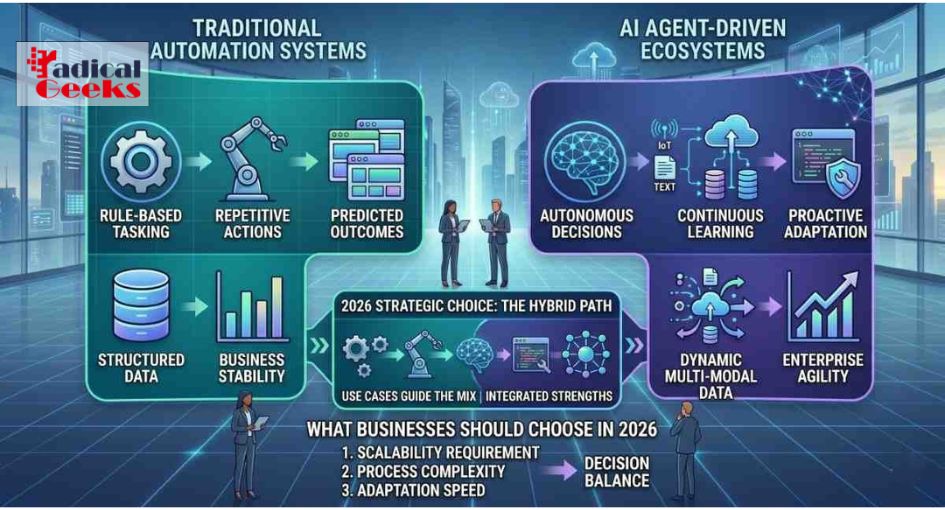
Businesses around the world are quickly embracing Artificial Intelligence as a way to increase efficiency, automate processes, and cut down costs. By 2026, automation is not only confined to simple, rule-based systems. Now, businesses are using smart AI agents that learn, adapt, and make independent decisions.
With digitalization moving fast forward, businesses are considering whether the traditional approach to automation is enough or if there is a need to consider AI agents.
AI agents in business operations are becoming one of the most significant tech trends since they offer sophisticated features like self-learning, decision-making based on prediction, and personal customer interaction. While traditional automation can be helpful, it might sometimes find it difficult to keep up with the constantly changing environment of the modern enterprise.
In this article, we will discuss what distinguishes AI agents from traditional automation, their benefits, drawbacks, and what option businesses should pick in 2026.
AI agents are intelligent software systems that can analyze information, make decisions, and perform tasks autonomously with minimal human intervention.
Unlike traditional automation systems, AI agents continuously learn from data and improve over time.
One of the main reasons why many companies adopt AI technology is that these programs can self-learn from user activity and live data.
Machine learning algorithms enable AI agents to:
It allows creating highly sophisticated intelligent automation systems.
Many organizations actively use intelligent software systems to increase their effectiveness and customer experience levels.
AI agents can make decisions without requiring predefined rules for every scenario.
These systems can:
This level of intelligence helps businesses reduce manual effort and accelerate productivity.
Customer support systems powered by AI technologies change the way businesses communicate with customers.
AI agents can:
Organizations that have AI-based customer support systems achieve higher efficiency and decrease operational expenses.
You can also explore:
Traditional automation is the type of technology that uses rule-based mechanisms to complete repetitive tasks.
Although traditional automation works efficiently for well-defined processes, they lack the intelligence that AI agents have.
Traditional automation technologies utilize hard-coded rules and workflows that are established by developers or systems administrators.
Some examples of rule-based mechanisms are:
These tools save time but lack learning abilities and adaptability.
Workflow automation helps companies automate repetitive operational activities.
Typically, workflow automation is used for the following purposes:
Traditional workflow automation is quite common since it is more efficient and economical for repetitive operations.
While an AI agent can adapt to any new situation that emerges, conventional automation processes do not have the ability to do this.
If there is a shift in business needs, changes must be manually made to automation processes.
This limitation reduces flexibility and scalability in fast-changing business environments.
While both increase efficiencies, they operate in fundamentally different ways.
AI agents are very flexible and adaptable. They can analyze changes in circumstances and adjust their behavior accordingly.
On the other hand, traditional automation software only follows pre-programmed instructions and cannot make any adjustments without human intervention.
Organizations operating in volatile environments may derive more benefits from automated systems driven by artificial intelligence.
AI agents learn from the available data and continuously improve their performance over time.
In contrast, traditional automation systems don’t learn anything on their own and need updates and optimization done by humans.
This ability to learn makes AI agents much more relevant in today’s digital world.
AI agents can communicate with customers using conversational AI and natural language processing.
They can interpret:
Unlike traditional automation systems, these tools are generally equipped with conversational intelligence.
AI agents can be easily scaled up and applied to several business processes and operations.
Companies can use AI-based systems in various departments such as:
As the operational complexity grows, it might become harder to deal with the traditional automated systems.
The implementation cost of the traditional automated system will be relatively low.
But with AI, the benefits include:
Effort reduction
Productivity
Better customer experience
Decision making automation
However, AI agents can provide greater long-term value by:
Businesses should evaluate both short-term and long-term ROI before choosing a solution.
AI agents are helping firms to develop intelligence, agility, and customer focus.
AI systems are capable of analyzing huge datasets and providing timely recommendations.
This means businesses benefit from:
AI agents provide organizations with intelligent insights and recommendations for decision-making.
AI agents can help analyze the behavior of customers and provide a personalized experience tailored to their needs.
Businesses use AI personalization for:
Personalization helps bussiness improve engagement and customer satisfaction.
Automated AI processes help reduce overhead costs.
Businesses can save costs through:
With AI workflow automation, organizations can operate more efficiently and lower their costs.
Unlike human teams, AI agents operate continuously without downtime.
This enables businesses to provide:
Systems working continuously improve customer satisfaction and operational consistency.
AI agents are actively adopted in multiple industries around the world.
Healthcare organizations use AI agents for:
AI-powered healthcare systems improve patient experiences and operational efficiency.
Financial institutions use AI agents for:
AI automation improves security and decision-making in the finance sector.
Retail companies use AI-powered systems for:
AI helps retailers improve conversions and customer retention.
Manufacturing companies use AI agents for:
AI improves operational efficiency and reduces downtime.
IT organizations use AI agents for:
AI-driven IT operations improve productivity and system reliability.
Although there are many strengths, AI agents also have some significant drawbacks.
AI systems require large amounts of data to function effectively.
Businesses must ensure:
Data security is critical for maintaining customer trust.
When provided with poor-quality data sets, AI agents may generate biased results.
Companies must continually audit their AI systems to guarantee fairness and accuracy.
AI-powered systems can become targets for cyberattacks and data breaches.
Businesses should implement:
You can also read:
The integration of AI agents into business operations can also prove to be difficult.
Organizations may face challenges related to:
Proper planning and reliable technology partners are crucial for implementing AI systems.
The right choice depends on business goals, operational complexity, and budget.
AI-driven automation is ideal for startups as it facilitates business growth and expansion with a smaller workforce.
You can use AI agents to help your startup streamline customer services, analytics, and marketing.
SMEs may take advantage of both traditional and AI automation based on their operational needs.
Rule-based automation may still prove effective when applied to simple and repetitive tasks.
If you run a large company, then it’s likely going to need intelligent AI automation tools designed to manage all sorts of complicated processes and interactions with clients.
AI agents prove superior at scaling up and adapting to changing situations.
Intelligent customer support teams should embrace AI automation through chatbots and virtual assistants that will enable them to respond faster and offer 24/7 support to customers.
Operations teams benefit from AI automation through:
AI helps businesses improve operational performance and reduce manual workloads.
The use of AI agents in the business environment in 2026 is revolutionizing the way operations are carried out. While conventional automation is still relevant for simple jobs, companies that are looking for scale, customization, and intelligent responses are now exploring automation with artificial intelligence.
Healthcare, financial services, retail, manufacturing, and information technology industries are some sectors that are currently using AI agents to boost their efficiency and performance.
With advances in technological innovations, businesses that embrace intelligent automation will have an advantage over their competitors in the digital age.
Here at Radical Geeks Technologies, we are committed to helping you leverage intelligent automation techniques and digital transformation initiatives.
An AI agent is an intelligent software system capable of learning, analyzing data, and performing tasks autonomously using Artificial Intelligence technologies.
Traditional automation follows predefined rules, while AI agents can learn, adapt, and make decisions independently based on data and user interactions.
The cost depends on complexity and implementation requirements. While AI systems may require higher initial investment, they often provide long-term operational savings.
Yes. Many AI-powered tools and cloud-based AI solutions are affordable and scalable for small businesses and startups.
Industries such as healthcare, finance, retail, manufacturing, customer support, and IT services benefit significantly from AI-powered automation.