
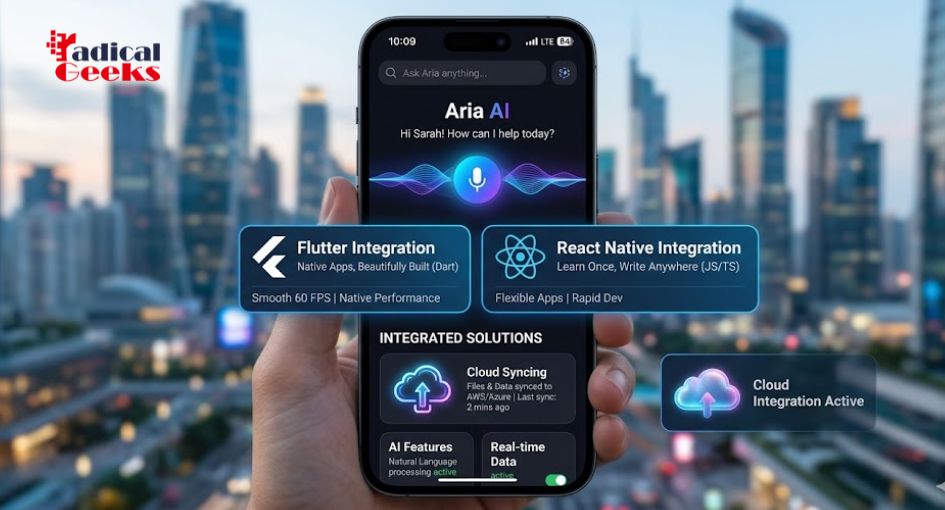
Mobile app development is evolving faster than ever before. In 2026, businesses are no longer treating mobile applications as optional digital tools. Mobile apps have become essential for customer engagement, automation, sales growth, and digital transformation.
With billions of smartphone users worldwide, companies are investing heavily in AI-powered mobile applications, cross-platform technologies, and seamless user experiences. Modern consumers expect apps to be intelligent, fast, secure, and highly personalized.
Artificial Intelligence, Super Apps, Progressive Web Apps (PWAs), and cross-platform frameworks like Flutter and React Native are shaping the future of the mobile industry. Businesses that adapt to these trends early will gain a significant competitive advantage in the digital economy.
Modern mobile applications are increasingly powered by Artificial Intelligence and emerging software development approaches.
In this article, we will explore the biggest mobile app development trends in 2026 and how organizations can leverage them to improve customer experience and business growth.
Mobile applications are now at the center of digital business strategies. Companies across industries are prioritizing mobile-first experiences to improve accessibility, customer retention, and operational efficiency.
Mobile commerce continues to grow rapidly as consumers increasingly prefer shopping through smartphones. E-commerce businesses are investing in mobile apps to provide faster checkout experiences, personalized recommendations, and real-time customer support.
Features such as one-click payments, AI-powered suggestions, and in-app wallets are helping businesses increase conversions and customer loyalty.
Artificial Intelligence is transforming how users interact with mobile applications. AI-driven apps can now understand user behavior, preferences, and habits to deliver highly personalized experiences.
AI integration helps businesses improve:
Modern mobile applications can learn from user activity and continuously improve the experience automatically.
Businesses are shifting toward mobile-first development strategies because customers spend most of their digital time on smartphones.
A mobile-first approach helps organizations:
Companies investing in mobile app development trends in 2026 are better positioned for long-term growth and digital transformation.
Artificial Intelligence is one of the biggest innovations in mobile technology. AI-powered mobile apps are becoming smarter, faster, and more efficient.
AI algorithms analyze customer behavior and provide personalized recommendations based on interests, browsing patterns, and previous purchases.
Popular platforms like Netflix, Amazon, and Spotify already use AI recommendation systems to improve customer engagement.
Businesses can use similar technologies to:
AI-powered chatbots are revolutionizing customer support and communication.
Modern AI chatbots can:
Businesses integrating AI chatbots into mobile apps can significantly improve customer service efficiency.
You can also explore our related articles:
Voice-enabled applications are becoming increasingly popular in 2026. AI voice assistants help users interact with apps using natural language commands.
Voice automation is improving:
Industries like healthcare, retail, and banking are rapidly adopting voice-powered mobile applications.
Predictive analytics uses AI and machine learning to forecast user behavior and business outcomes.
Businesses can use predictive analytics to:
AI-driven insights allow organizations to make smarter business decisions using real-time mobile data.
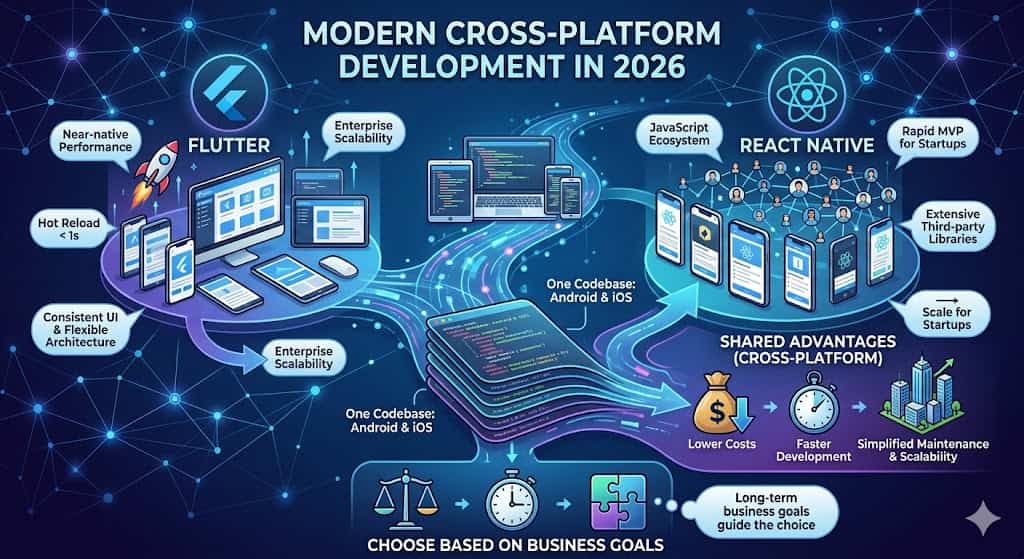
Cross-platform app development continues to dominate the mobile industry because businesses want faster development and lower costs.
Flutter and React Native remain two of the most popular frameworks in 2026.
Flutter delivers near-native performance because it uses its own rendering engine. React Native relies on native components, which may slightly affect performance in complex applications.
For high-performance applications, Flutter often provides smoother UI rendering and better animation performance.
React Native has a large ecosystem and extensive third-party libraries, which can speed up development for certain projects.
Flutter also offers rapid development using Hot Reload technology and customizable widgets.
Both frameworks support faster development compared to native app development.
Cross-platform development reduces overall project costs because developers can maintain a single codebase for Android and iOS platforms.
This approach helps businesses:
Flutter is increasingly preferred for scalable enterprise applications due to its consistent UI and flexible architecture.
React Native remains popular among startups and businesses with JavaScript-based ecosystems.
For startups, both frameworks are excellent choices. The final decision depends on:
Businesses should choose a framework based on long-term business goals rather than short-term trends.
Super Apps are transforming the digital ecosystem by combining multiple services into a single application.
These all-in-one platforms integrate:
Apps like WeChat have demonstrated how powerful Super Apps can become.
Super Apps offer several advantages:
Businesses benefit from keeping users within one unified platform.
Companies are investing in Super Apps because they create stronger customer relationships and generate multiple revenue streams from a single platform.
Super Apps also improve:
As digital ecosystems expand, more businesses are expected to adopt Super App models in 2026 and beyond.
Progressive Web Apps are becoming a cost-effective alternative to traditional native applications.
PWAs combine the benefits of websites and mobile applications while providing fast and responsive experiences.
PWAs load quickly and work efficiently even in low-network conditions.
Faster loading speeds improve:
Unlike native apps, PWAs are indexed by search engines, which provides better visibility in Google search results.
Businesses using PWAs can improve:
PWAs reduce development costs because businesses only need a single web-based solution instead of separate Android and iOS applications.
This makes PWAs ideal for:
Businesses investing in technical SEO and mobile optimization can significantly improve the visibility and performance of Progressive Web Apps.
As mobile applications become more advanced, cybersecurity threats are also increasing.
Businesses must prioritize security to protect customer data and maintain trust.
Cybercriminals are using AI to launch more sophisticated attacks against mobile applications.
Threats include:
Organizations must implement advanced security systems to reduce risks.
You can also read:
Data encryption helps protect sensitive user information during transmission and storage.
Strong encryption standards are essential for:
Multi-factor authentication (MFA) adds an additional layer of security by requiring multiple verification methods.
MFA significantly reduces unauthorized access and improves account security.
Cloud-connected mobile applications must use secure APIs and cloud security protocols to prevent data breaches.
Businesses should adopt:
Selecting the right mobile app development company is critical for project success.
Businesses should evaluate development partners based on:
An experienced technology partner can help businesses build scalable and future-ready mobile applications.
Companies planning digital transformation initiatives should invest in scalable mobile technologies and AI-driven business solutions.
At Radical Geeks Technologies, we help organizations develop intelligent, secure, and scalable mobile applications tailored to modern business needs. Our expertise in AI integration, cross-platform development, and digital transformation enables businesses to stay competitive in the evolving mobile ecosystem.
The future of mobile app development in 2026 is being driven by Artificial Intelligence, cross-platform technologies, Super Apps, and enhanced mobile security.
Businesses are increasingly investing in intelligent mobile applications to improve customer experiences, automate operations, and accelerate digital transformation.
Technologies like Flutter, React Native, AI-powered chatbots, predictive analytics, and PWAs are reshaping the mobile industry. Companies that adopt these innovations early will gain stronger market advantages and better customer engagement.
As mobile technology continues to evolve, organizations must focus on scalability, security, and user-centric design to remain competitive in the digital era.
Both Flutter and React Native are excellent frameworks. Flutter offers better UI consistency and performance, while React Native provides a large ecosystem and faster JavaScript-based development.
Super Apps are all-in-one applications that combine multiple services such as messaging, payments, shopping, and banking into a single platform.
AI improves mobile apps through personalized recommendations, AI chatbots, predictive analytics, automation, and voice assistant integration.
PWAs are cost-effective and SEO-friendly, while native apps provide deeper hardware integration and higher performance. The best option depends on business requirements.
Mobile security protects sensitive user data, prevents cyberattacks, and helps businesses maintain customer trust and regulatory compliance.