
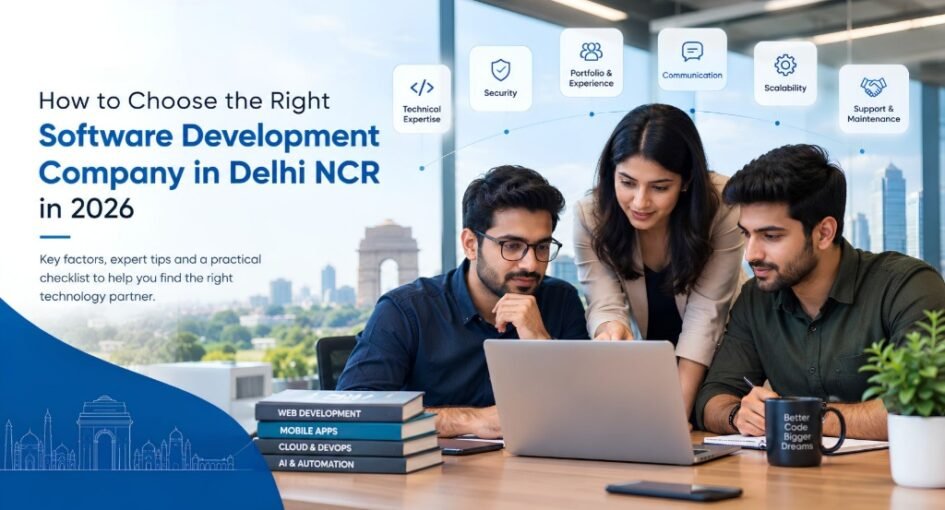
Choosing the right software development company in Delhi NCR can have a major impact on the success of your digital product.
Whether you are building a SaaS platform, business application, mobile solution, customer portal, or enterprise software, the development partner you choose can influence everything from product quality and security to scalability, cost, and long-term maintenance.
Delhi NCR has a large and diverse technology ecosystem, with software development companies serving startups, SMEs, enterprises, and international businesses. This makes the choice more valuable—but also more complicated.
Instead of selecting a development company based only on price, location, or marketing claims, businesses should evaluate its technical expertise, relevant experience, development process, communication, security practices, ownership terms, and post-launch support.
If you are evaluating software development services in Delhi NCR, here are the key factors to consider before making a decision.
Software development is more than writing code.
A successful project requires business analysis, product planning, UI/UX design, architecture, development, testing, deployment, security, and ongoing maintenance. A weakness at any stage can create problems later in the product lifecycle.
For example, unclear requirements can lead to scope changes.
Poor architecture can make future scaling difficult.
Insufficient testing can result in bugs after launch.
And inadequate security practices can expose sensitive business or customer data.
This is why businesses should look for a development partner that understands both technology and business objectives.
The right partner should be able to translate your business requirements into a practical technology solution while keeping scalability, usability, security, and future maintenance in mind.
One of the first things to evaluate is whether the company has experience building solutions similar to yours.
A company may have years of experience in software development, but that does not automatically mean it has experience with your specific type of product.
For example, developing a CRM, SaaS platform, healthcare application, ecommerce marketplace, fintech solution, or internal enterprise system can involve very different requirements.
Look for experience in areas such as:
Ask the development company about projects that demonstrate relevant technical and industry experience.
The goal is not simply to find a company that has built many applications. It is to find a team that understands the type of application and business problem you are trying to solve.
A professional website can tell you about a company’s services, but a portfolio can provide much more practical information.
Before selecting a software development partner, examine its previous work.
Look for:
If possible, ask for case studies rather than only screenshots.
A useful case study should explain the original business challenge, the solution implemented, the technologies involved, and the outcome.
You can also ask whether the company has experience taking products from an initial MVP to later stages of development and scaling.
A reliable development company should have a structured process.
Before signing a contract, ask how the company handles your project from the initial idea to deployment.
A typical software development process may include:
A development partner should also explain how changes to requirements will be handled.
For example, ask:
A clear process reduces misunderstandings and gives both sides a better understanding of project responsibilities.
Good communication is one of the most important parts of a successful software project.
You should know who will communicate with you throughout the development process and how often you will receive updates.
Before hiring a company, clarify:
This becomes particularly important for complex projects involving multiple teams.
A technically strong development company still needs an effective communication process to keep business stakeholders, designers, developers, testers, and project managers aligned.
Security should be considered from the beginning of software development rather than only after a product is completed.
Ask potential development partners how they approach:
A useful reference point is the NIST Secure Software Development Framework (SSDF), which provides practices for integrating security into the software development lifecycle.
For a deeper look at security-focused development practices, see our guide to DevSecOps and secure software development.
For companies dealing with financial, healthcare, customer, employee, or other sensitive information, security requirements should be discussed during the planning and architecture stages.
Security should not be treated as a final checklist item. It should be part of requirements, design, development, testing, deployment, and maintenance.
This is an important point that businesses sometimes overlook when hiring a software development company.
Before development begins, make sure the contract clearly explains ownership of:
Also clarify where the source code will be stored and who will have access to the repositories.
If your business is investing in custom software, you should understand exactly what will be delivered at the end of the project.
An NDA may also be appropriate when discussing confidential product ideas, business processes, technical architecture, or proprietary information.
Cost is naturally an important consideration, but the cheapest development quote is not necessarily the lowest-cost solution in the long term.
A low initial estimate can sometimes exclude important components such as:
Instead of comparing only the final number, compare what is actually included in each proposal.
For example:
| Factor | Questions to Ask |
|---|---|
| Scope | What features are included? |
| Design | Is UI/UX included? |
| Development | Which technologies will be used? |
| Testing | What types of testing are included? |
| Deployment | Who handles production deployment? |
| Support | What happens after launch? |
| Ownership | Who owns the source code and IP? |
| Maintenance | Is ongoing support available? |
| Scalability | Can the architecture support future growth? |
A transparent proposal makes it easier to compare development partners based on the actual scope of work.
Launching software is not the end of the development lifecycle.
Applications often require ongoing:
This is particularly important for SaaS platforms and business-critical applications.
Before hiring a development company, ask whether it provides post-launch maintenance and support.
A company that can support the product after deployment can potentially make long-term management simpler because the development team already understands the application’s architecture and codebase.
Before signing an agreement with a software development company in Delhi NCR, consider asking the following questions:
These questions can help you understand how a company operates before committing significant time and resources to the project.
Radical Geeks Technologies provides software development services for businesses working on custom applications, SaaS products, migrations, maintenance, and other software requirements.
According to its software development service page, the company works across the software development lifecycle, including project analysis, proof of concept, user stories, mockups, wireframes, architecture, development, testing, deployment, and maintenance.
The company also lists application migration, SaaS development, bespoke software development, and maintenance and support among its capabilities. It describes experience supporting products from initial MVP development through later stages of scaling.
For businesses considering a custom application, this broader development lifecycle can be useful because software requirements often evolve after the initial product is launched.
For example, a business may start with an MVP and later require additional APIs, automation, mobile applications, analytics, cloud infrastructure, or integrations.
The technology partner should therefore be capable of supporting not only the initial build but also future product development.
Another important decision is whether your business needs custom software or an existing off-the-shelf solution.
Off-the-shelf software can be useful when your requirements closely match the features already available.
Custom software may be more appropriate when you need:
Businesses evaluating this decision should first identify their actual operational requirements instead of choosing technology simply because it is popular. Learn more about the advantages of custom software development.
The right approach depends on factors such as budget, business processes, scalability, integration requirements, and the expected lifetime of the software.
Modern software projects increasingly involve more than a traditional web application.
Depending on the business model, you may need:
Businesses developing customer-facing applications may also want to consider current mobile app development trends in 2026.
Similarly, companies exploring intelligent automation may need to determine whether traditional rule-based automation or AI-based systems are more appropriate for a particular workflow.
Understanding the difference between AI agents and traditional automation can help businesses evaluate which approach fits their requirements.
The important point is that technology should support the business requirement—not the other way around.
Before making a final decision, review the following checklist:
| Area | What to Check |
|---|---|
| Experience | Relevant projects and industry experience |
| Portfolio | Real applications and case studies |
| Technology | Suitable and maintainable technology stack |
| Process | Clear development and delivery methodology |
| Communication | Defined contacts and reporting process |
| Security | Security integrated into the development lifecycle |
| Testing | Manual, automated, functional and performance testing where appropriate |
| Ownership | Source code and intellectual property terms |
| Pricing | Transparent scope and cost structure |
| Scalability | Ability to support future growth |
| Support | Maintenance and post-launch assistance |
A company that can provide clear answers across these areas gives you a much better basis for evaluating the partnership.
Choosing a software development company in Delhi NCR should be based on more than a company’s location or quoted price.
Businesses should evaluate experience, portfolio, technical capabilities, development processes, communication, security, ownership, testing, scalability, and post-launch support before making a decision.
The right development partner should understand your business objectives and translate them into a practical, maintainable technology solution.
If you are currently evaluating development companies, create a shortlist and ask each provider the same core questions.
Compare their experience, proposed approach, deliverables, timelines, technology choices, ownership terms, and support structure.
That process can make it much easier to identify a development partner that matches your project’s actual requirements.
Start by evaluating the company’s relevant experience, portfolio, technical expertise, development process, communication, security practices, pricing transparency, source-code ownership, and post-launch support.
The cost depends on factors such as project complexity, number of features, UI/UX requirements, technology stack, integrations, platforms, development timeline, testing requirements, and ongoing support.
A reliable development company should first understand the project scope before providing a meaningful estimate.
Location can be useful when you prefer easier communication, local business understanding, or in-person meetings. However, technical capabilities, communication processes, experience, security, and long-term support should also be considered.
Depending on the agreement, post-launch services can include bug fixing, security updates, performance optimization, infrastructure support, feature enhancements, monitoring, and ongoing maintenance.
Security is important for virtually every modern software project, particularly applications handling sensitive business or customer information.
Businesses should ask potential development partners how security is incorporated into requirements, architecture, development, testing, deployment, and maintenance.